
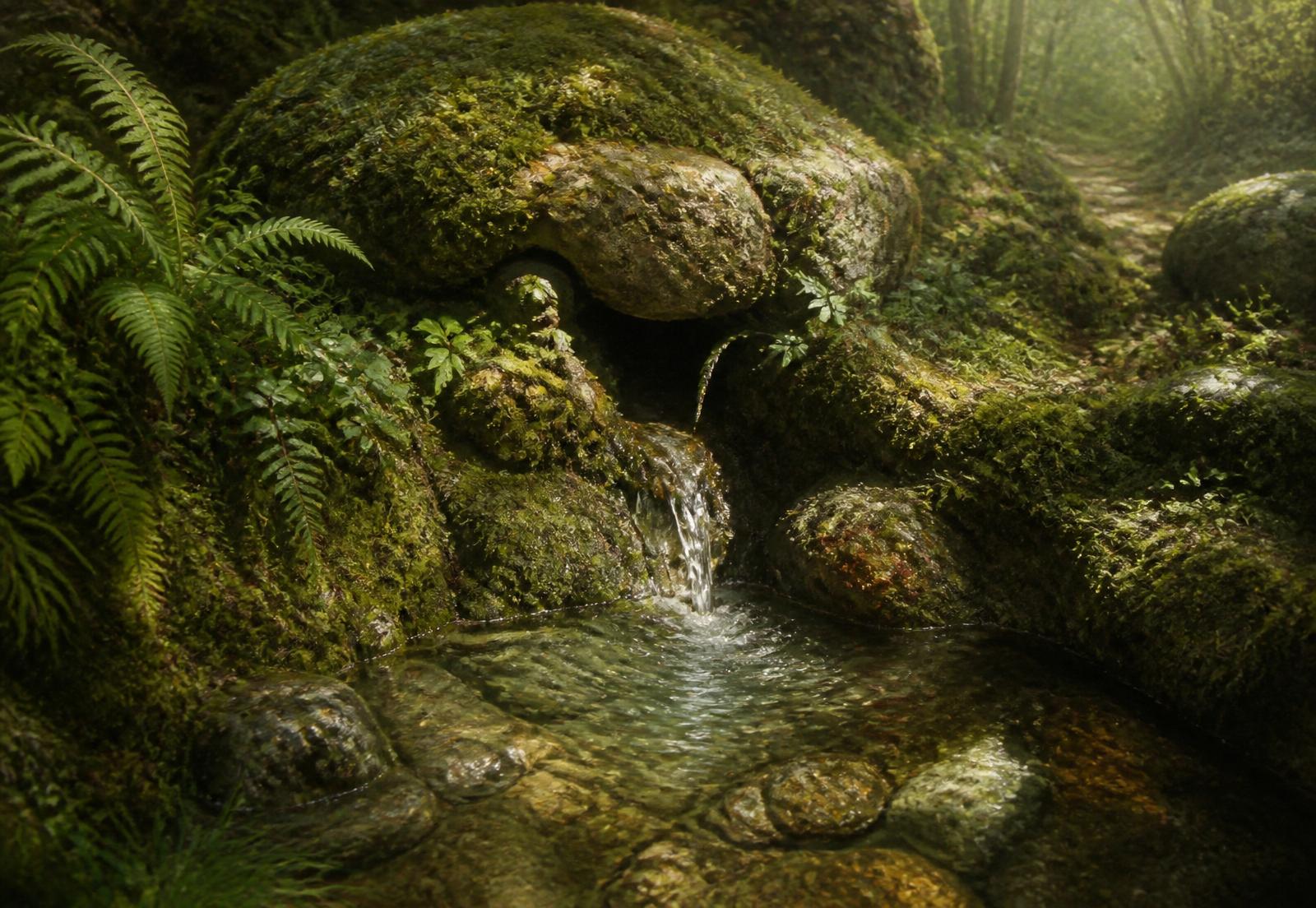
Saint Thøger's Spring
One of Denmark's oldest sacred waters — said to have appeared where a sleepless monk laid his head nearly a thousand years ago.
"He took it as a good omen."
Saint Thøger was born around the year 1000. He served King Olaf II Haraldsson of Norway — Saint Olaf, Rex Perpetuus Norvegiæ, Norway's eternal king — as his chaplain.
When the king died in 1030, Thøger crossed the sea to Denmark and settled in Vestervig. There he built a small church with his own hands, from twigs and branches, to honour God.
One evening, he went to bed sorrowful, unable to find proper shelter. When he rose in the morning, a spring had emerged where his head had lain. He took it as a sign from God, and built a true church not far from the water.
For nearly a thousand years, pilgrims have come.
The healing tradition of Danish holy springs.
A holy spring is one whose water is believed to carry healing properties. According to Danish folklore, the power of the water reached its peak on Walpurgis Night (30 April) and Midsummer Eve (23 June) — the preferred times to visit.
People came seeking relief from arthritis, paralysis, wounds and sores, skin conditions, and stomach and eye diseases. They left coins, candles and quiet prayers in return.
Still rising from the Danish earth.
The original spring lay southwest of the church, but was buried under the ruins of the medieval monastery. Slightly further south, however, a natural spring still emerges from the ground at coordinates 56°45'16.7"N 8°18'57.1"E.
A small creek runs north from this spring, and many believe it carries the same waters that once flowed from Saint Thøger's holy well. Pilgrims walking the Northern Pilgrim Way are invited to pause here before completing the final kilometres into Vestervig.